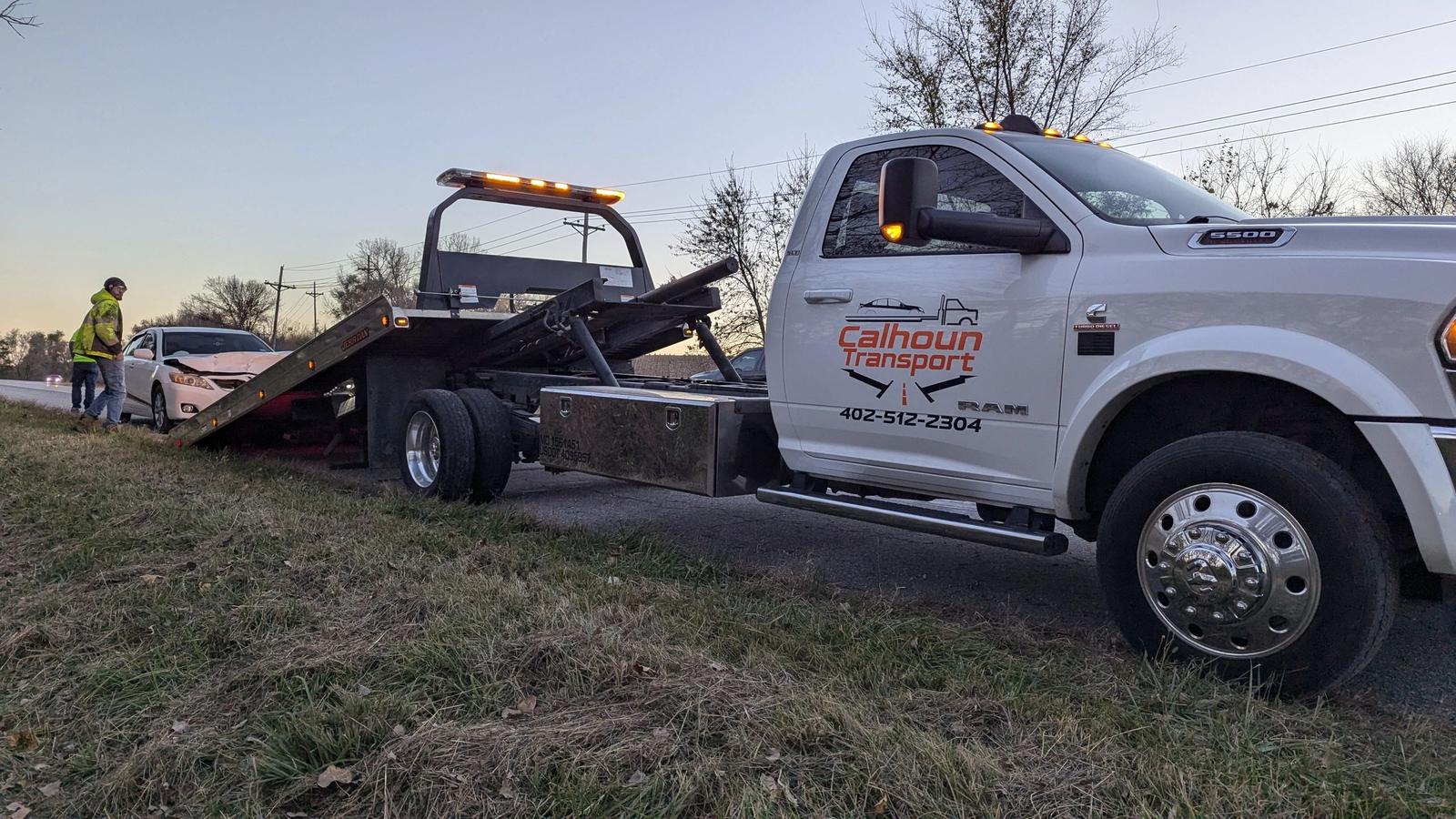
If your vehicle dies on I-80 in Omaha, get it onto the right shoulder if it will still move, turn on your hazards, and get yourself out on the side away from traffic. Then call for a tow with your direction of travel and the nearest exit number. The vehicle is replaceable. The shoulder is where people get hurt.
The shoulder is the actual hazard
The Nebraska Department of Transportation has described the stretch of I-80 through the middle of Omaha as carrying the most traffic of any roadway in the state. The regional planning agency's interchange counts put I-680 at I-80 above 230,000 vehicles a day, with the 72nd, 84th, 60th and 42nd Street interchanges all above 195,000.
That is the context for every decision you make in the next twenty minutes. A stationary vehicle on a shoulder with traffic passing at speed a few feet away is not a place to check your phone, look under the hood, or wait in the driver's seat with the door open into the lane.
What to do, in order
- Keep it rolling if you can. A vehicle that still moves under its own power should be moved to the widest shoulder available, or better, off at the next exit.
- Hazards on immediately, before you have finished deciding anything else.
- Get out on the passenger side if you are on the right shoulder, and move away from the vehicle, up the embankment if there is one.
- Do not stand behind the vehicle. A rear-end impact pushes it exactly where you are standing.
- Do not try to change a tire on the traffic side. It is not worth it, and this is what a roadside call is for.
What to tell whoever you call
Four things get the right truck to you the first time: the road, the direction you were travelling, the nearest exit number or cross street, and the year, make and model of the vehicle.
Then one more that people leave out: whether the vehicle still rolls and steers. A car that will not roll needs to be winched onto the deck, and a car that is lowered needs extra ramps on the truck before it leaves. Both of those are decided when the call is taken, not when the driver arrives and discovers the situation.
Why the work zones matter this year
Omaha's interstate is under construction in more than one place. NDOT began widening I-680 between the Center and Pacific area and Dodge Street in 2026, and the southbound ramp from Pacific closed from late July 2026 into the autumn. A separate I-80 repair and expansion project through the 50th Street area is planned to start as early as spring 2027.
Work zones narrow shoulders and change where there is physically room to load a vehicle. If you are inside one, say so when you call. It affects how the truck sets up and sometimes whether the vehicle has to be moved a short distance first.
What it costs, and why nobody quotes it online
Nobody can give you an honest interstate tow price from a web page, and any figure you see on one is either a lowball to get the call or an average that will not match your situation.
Four things move the number. How far the vehicle has to travel, which is usually most of it. What it weighs, because a half ton pickup and a work truck are not the same job. Whether it has to be winched before it can be loaded, which is a different piece of work from a straight drive-on. And where it is sitting, because a vehicle on a live interstate shoulder inside a work zone takes longer to load safely than one in a parking lot.
The practical version: describe the situation accurately on the phone and you get a real figure before a truck moves. Describing it accurately is also in your interest, because the two details people most often leave out, that the car will not roll and that it sits low, are exactly the two that change which truck gets sent.
When it is not a tow at all
A meaningful share of interstate calls do not need a tow. A dead battery, a flat with a usable spare, or an empty tank are roadside jobs, and they are priced as roadside jobs rather than as a tow with a loaded delivery on the end of it.
The distinction is worth making on the phone rather than after a truck arrives. If the fix will not hold, say a battery that goes flat again because the alternator has quit, the honest move is to load the vehicle instead of taking your money twice. You should expect to be told which one you have.
Frequently Asked Questions
Should I stay in my car on the interstate?
Generally no, not on a busy interstate shoulder. Get out on the side away from traffic and move well clear of the vehicle. The exception is severe weather or a situation where getting out puts you closer to the traffic lane, in which case stay belted in with the hazards on.
How do I describe where I am on I-80?
Give the direction you were travelling and the nearest exit number, which is the fastest way for a driver to find you. Mile markers work too. Naming a cross street alone is not enough on an interstate, because the same street can cross it a long way from where you actually are.
Will my all-wheel drive car be towed differently?
Yes. All-wheel drive and four-wheel drive vehicles should not be towed with two wheels turning on the road, and many owner manuals prohibit it outright. It goes on a flatbed with all four wheels off the ground. Mention the drivetrain when you call so the right truck is sent.
Is it cheaper to get a jump start than a tow?
Yes, meaningfully, because it is a shorter job with no loaded delivery. If your problem is a dead battery, a flat tire or an empty tank, that is a roadside call and it should be priced as one. Describe the symptoms accurately and you may not need a tow at all.
If you need a truck now
Calhoun Transport runs flatbeds across the Omaha metro and Washington County from a base in Fort Calhoun. Call 402-512-2304 with your location and you will get a real price before anything is dispatched. More detail on how the loading works is on the flatbed towing page, and the roadside side of it is covered under roadside assistance. If you are inside the city, the Omaha service area page has the local detail. For anything that is not urgent, send us the details instead.