Roadside assistance is the work that gets you moving again without a tow. Calhoun Transport runs roadside calls across the Omaha metro and Washington County, Nebraska, from a base in Fort Calhoun. A dead battery, a flat tire and an empty tank are three different problems with one thing in common: the vehicle is fine, and it only needs one thing done to it before it drives away.
That distinction is worth making on the phone, because it changes the price and it changes the truck. A jump start is a short visit. A tow is a loaded deck and a delivery. If what you have is a roadside problem, there is no reason to pay for a tow, and we would rather tell you that up front than load a car that did not need loading.
Tell us where you are, what you are driving, and what it is doing. Most roadside calls are diagnosed accurately over the phone in under a minute, which means the right gear is already on the truck when it arrives.
When roadside works, and when it does not
Roadside assistance solves a specific class of problem: the vehicle is mechanically sound and something outside the engine has stopped it. A battery that has gone flat overnight, a tire that picked up a screw, a fuel gauge that was optimistic. Fix that one thing and the vehicle drives home under its own power.
It does not solve a problem that is going to repeat in two miles. A battery that will not hold a charge because the alternator has quit will start on a jump and die again the moment the cables come off. A tire with a sidewall tear cannot be safely aired up. When that is what we find, the honest move is to say so and load the vehicle instead of taking your money for a fix that will not last past the next stoplight.
We will tell you which one you have. If a jump start turns into a tow because the charging system is dead, you find that out on the shoulder from the person holding the cables, not two exits later.
What we handle on a roadside call
- Jump starts for cars, pickups and work trucks
- Tire changes using your spare, including full-size and compact spares
- Fuel delivery when the tank has run dry, gas or diesel
- A second opinion on whether the vehicle is safe to drive away
- A tow on the same visit if the roadside fix will not hold
What a roadside call includes
A price on the phone
Distance and what you need decide the number. You hear it before anything is dispatched, and a roadside call is priced as a roadside call, not as a tow.
Proper jump equipment
A jump pack sized for the vehicle rather than a set of cables and a guess. Modern electronics do not tolerate a sloppy jump, and a work truck is not a hatchback.
Your spare, mounted correctly
The spare goes on with the wheel torqued, not hand tight. If your spare is missing, flat or a temporary donut that is not safe for the distance you need, we will say so.
Fuel enough to get somewhere
We bring enough to get you to a station under your own power, not enough to finish your trip. That is the point of the service and it keeps the price sane.
An honest diagnosis
If the battery is the symptom and the alternator is the cause, you get told. A jump that gets you two miles down the road is not a service, it is a delay.
A tow if it comes to that
Same crew, same visit, no second call and no second wait. The flatbed is already there.
How a roadside call goes
You describe it
Road or cross streets, the year make and model, and what the vehicle is doing. Cranking, clicking, silent, or a tire that is flat.
We quote it
Roadside pricing, based on distance and what is needed. You get the number before a truck is sent.
We get to you safely
Lights on, approached from the correct side, and set up so the work happens away from the traffic lane.
We fix it or we load it
The jump takes, the spare goes on, the fuel goes in. If it will not hold, the deck comes down instead.
Winter is when the phone rings
Cold weather is hard on batteries in a way that catches people out every year. A battery that started the car fine in October can fail on the first genuinely cold morning, because low temperatures cut the current a battery can deliver at the same time as thickening the oil the starter has to turn. Nothing changed overnight. The margin just ran out.
Nebraska supplies plenty of those mornings. Omaha averages close to 29 inches of snow a season and January averages sit in the low twenties, which is exactly the range where a marginal battery stops being marginal. The same weather takes out tires, because cold air drops tire pressure and the potholes that freeze and thaw cycles open up in the pavement finish the job.
The practical version: if your vehicle has been slow to start on cold mornings, that is the warning. Getting the battery tested in November is cheaper than a roadside call in January, and we would honestly rather tell you that than come out twice.
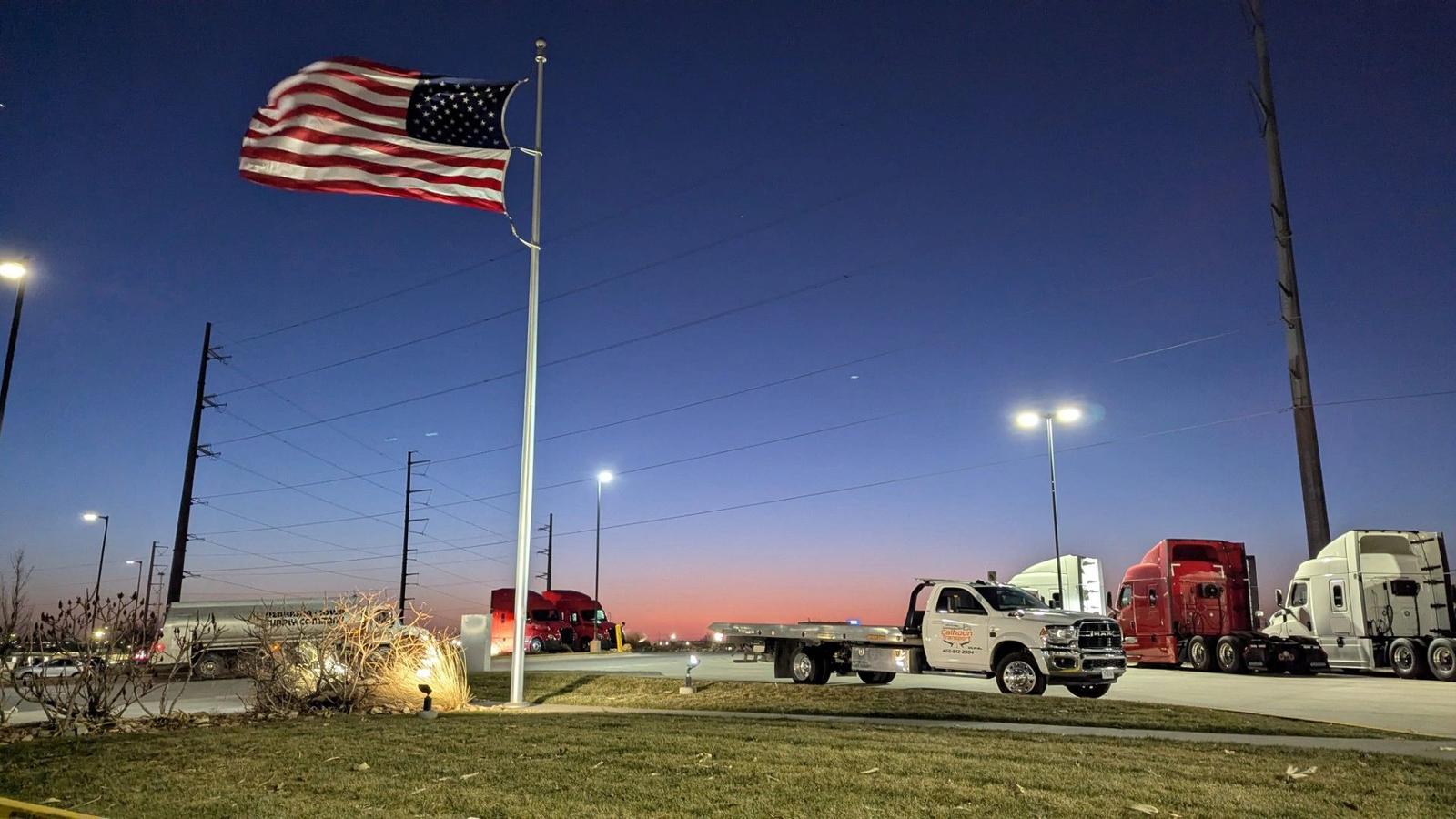
Where roadside calls happen around here
In the metro it is mostly interstate and arterial work. I-80 and I-680 carry the volume, and the I-80 stretch through the middle of Omaha is the busiest roadway in the state according to the Nebraska Department of Transportation. A flat on that shoulder is not a place to spend a long time, so the priority is getting the work done and getting you back into traffic.
Off the interstate the pattern changes. Dodge Street, the West Dodge corridor and the Maple and Center arterials produce a steady share of dead batteries in parking lots, which is a much better place to break down than a shoulder. The Saddle Creek underpass under Dodge has flooded chronically since it was built in 1934, and a vehicle that has been through standing water is a tow, not a jump start.
North of the city, roadside calls happen on Highway 75 and on the county roads off it, where the nearest help is measurably further away. That is the argument for a local truck. Herman has no fuel or repair facility on its own critical facilities list, and the nearest towns of any size are Blair to the south and Tekamah to the north. When you are out there, the difference between a nearby truck and a metro dispatch is real time on the shoulder.
Where we run roadside calls
Roadside runs the same footprint as everything else: the Omaha metro and Washington County. Being based in Fort Calhoun is the whole point on this service, because a jump start is a short job and the drive is most of the cost.
Pick your town below for the local detail, or just call and describe where you are.
Roadside Assistance near you
Roadside Assistance FAQs
Do I need to be with the vehicle?
For a jump start or a tire change, yes, or at least somebody who can move it afterwards. Fuel delivery sometimes works without you there if the vehicle is accessible and unlocked. Say on the phone whether you will be there, because it changes what we can actually complete.
Will a jump start damage my car's electronics?
Not when it is done properly. We use a jump pack sized for the vehicle rather than running cables off another engine, which keeps the voltage controlled. The risk people have heard about comes from bad connections and mismatched equipment, and that is exactly what proper gear is for.
What if my spare is flat or missing?
Then a tire change is not possible and the vehicle needs to go somewhere on the deck instead. It is worth checking your spare before you need it. Compact spares also lose pressure sitting in the trunk for years, so a spare that exists is not automatically a spare that works.
How much fuel do you bring?
Enough to get you to a station under your own power, not enough to fill the tank. That is what keeps the service quick and the price reasonable. Tell us whether the vehicle takes gas or diesel when you call, because arriving with the wrong one helps nobody.
Can you jump a diesel or a work truck?
Yes. Diesels and larger work trucks need considerably more starting current than a car does, which is why the equipment matters more than usual. Tell us what it is on the phone so the right pack comes out and we are not making a second trip for the sake of it.
Is roadside cheaper than a tow?
Yes, meaningfully, because it is a shorter job with no loaded delivery at the end. That is the reason it is worth describing the problem accurately when you call. If what you have is a flat tire, there is no sense paying for a tow, and we will tell you that on the phone.
Often needed together
Flatbed Towing
Cars, pickups, medium duty trucks and equipment hauled on a flatbed deck, so nothing drags, scrapes or turns a wheel on the way.
Learn moreWinch Out & Recovery
Off the shoulder, into the ditch, buried in mud or snow. Winched back onto the road without tearing up the vehicle.
Learn moreAccident Recovery
Careful recovery after a collision, secure storage for the vehicle, and straight paperwork for whoever is handling the claim.
Learn moreNeed a truck out to you?
Tell us where you are, what you are driving, and what happened. Calling is fastest, and it is the only way to get a real price before anything moves.