Services
Flatbed Towing in Omaha and Washington County
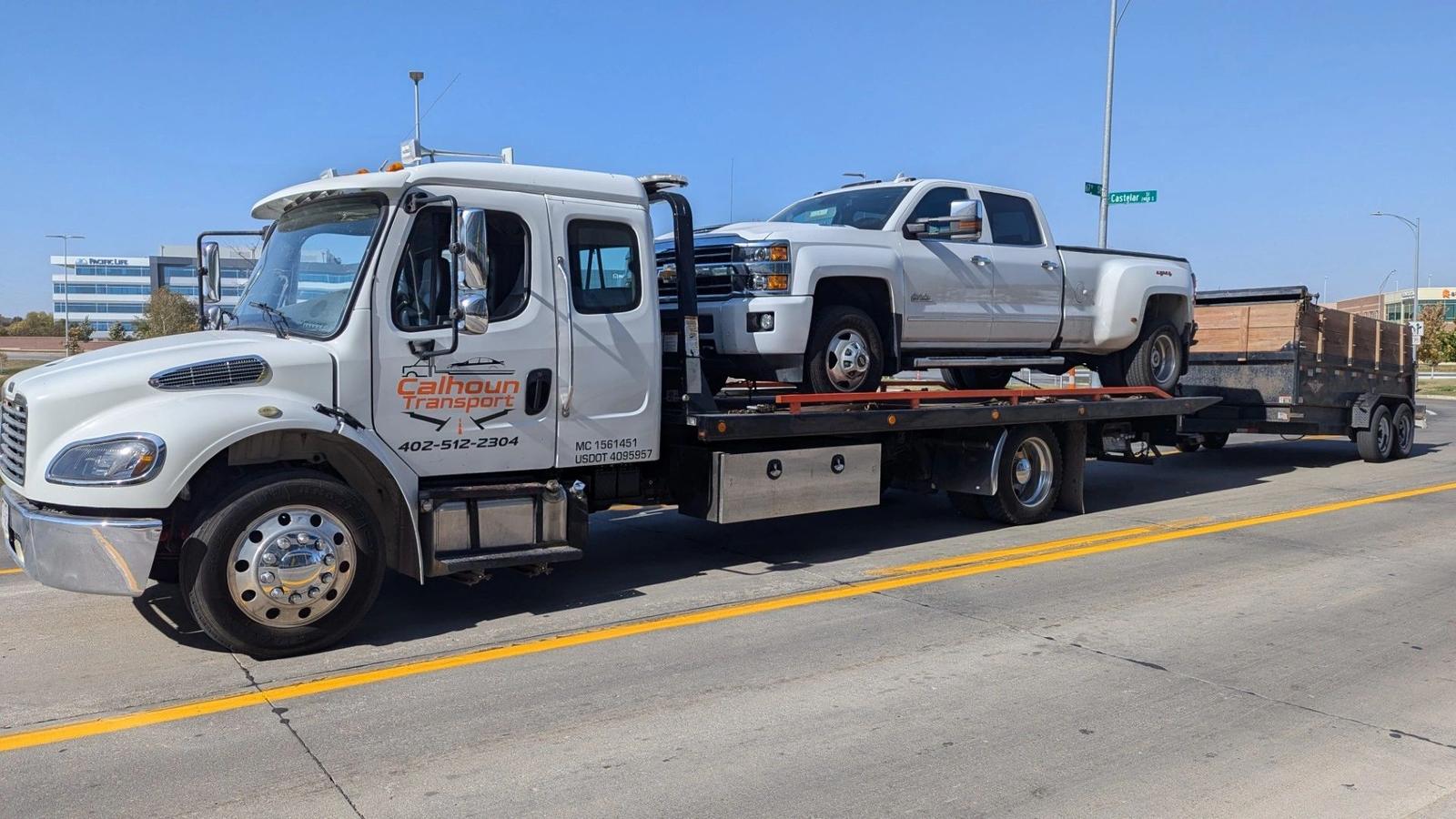
Light and medium duty flatbed hauling for cars, pickups, trucks and equipment. The vehicle rides on the deck, so nothing spins, scrapes or takes wear on the way.
Light and medium duty flatbed hauling for cars, pickups, trucks and equipment. The vehicle rides on the deck, so nothing spins, scrapes or takes wear on the way.
Flatbed towing means the whole vehicle is carried on a level steel deck instead of being lifted at one end and dragged down the road on its own tires. Calhoun Transport runs flatbeds out of Fort Calhoun, Nebraska, and covers the Omaha metro and Washington County with them. It is the method we use for almost every call, because it is the method that leaves the vehicle in the same condition it was in when we got there.
That matters more than it used to. Modern cars are lower, wider and more likely to be all-wheel drive than the cars towing equipment was designed around. A vehicle that gets dragged on two wheels is spinning a differential with no oil pressure behind it, scrubbing tires, and putting an air dam a few inches from the pavement for the entire trip. On a deck, none of that happens.
If you are stranded right now, calling is faster than anything on this page. Give us the road or the nearest cross streets, the year, make and model, and what happened. That is enough to send the right truck with the right gear on it and to give you a real price before it moves.
A wheel lift is a good tool for a short move of a simple vehicle. It picks up the drive wheels, leaves the other two on the ground, and rolls. For a front-wheel drive sedan going four blocks, that is fine and nobody should pretend otherwise. The trouble starts as soon as the vehicle is anything other than that.
All-wheel drive and four-wheel drive vehicles are the clearest case. With two wheels turning on the road and two lifted, the center differential and transfer case are being driven with the engine off. Plenty of manufacturers put a flat-tow prohibition in the owner's manual for exactly this reason. A flatbed sidesteps the argument entirely, because nothing on the vehicle is rotating.
Then there is everything that will not cooperate. A car with a seized wheel bearing, a locked parking brake, a flat that has been driven on, a snapped tie rod after a collision, or no key at all cannot be rolled onto anything. On a flatbed it does not need to roll. The deck tilts, the winch line goes on, and the vehicle comes up whether it wants to or not.
Distance, weight and whether the vehicle needs winching decide the number. You hear it on the phone, not when the truck is already sitting in front of you.
A half ton pickup and a medium duty work truck are not the same job. Telling us the vehicle up front means the correct deck arrives the first time.
Flat, seized, wrecked or keyless. The line goes on and the vehicle comes up the deck under control instead of being pushed.
Load securement runs through the wheels and tires wherever the vehicle allows it, so the suspension and body panels stay out of the load path.
Extra ramps to flatten the approach angle for lowered cars, long front overhangs and aggressive splitters.
Shop, dealership, auction lot, your driveway or storage. You get told where the vehicle went and who took it.
Road or cross streets, year make and model, and what happened. Mention it if the vehicle is lowered, in a ditch, or will not roll.
Weight, distance and recovery difficulty. You get the number before anything is dispatched, not after.
The bed tilts back to the ground and the ramps come out if the approach angle needs flattening.
The vehicle comes up the deck on the winch line, then gets secured at the wheels and the deck goes level.
Straight to the destination, unloaded the same controlled way, and handed to whoever is receiving it.
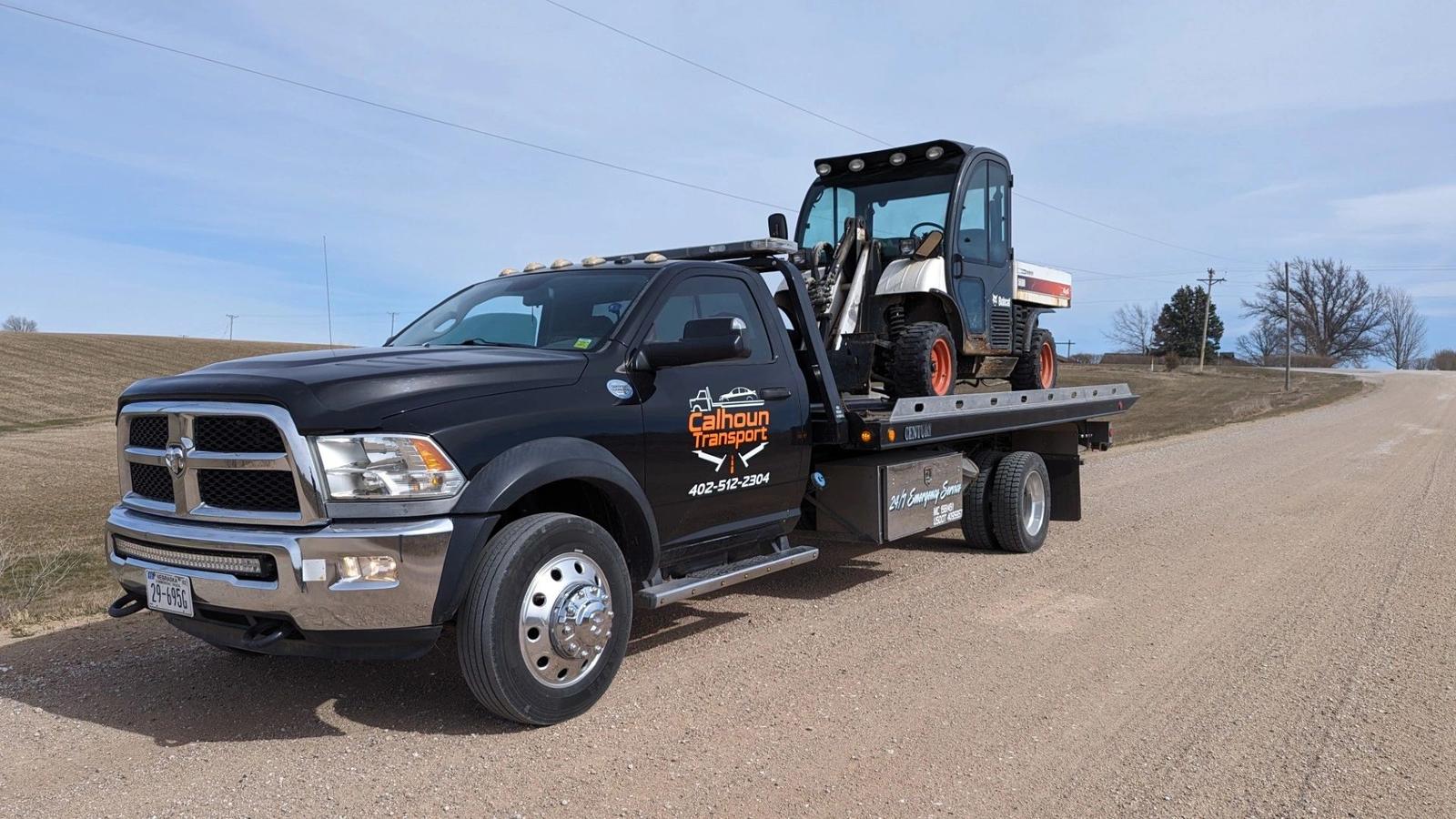
A flatbed does not care whether the thing on it has a license plate. The same trucks that carry cars carry skid steers, compact tractors, mowers, scissor lifts and pallets of material, and a good share of the week is spent doing exactly that rather than roadside work.
For contractors this usually beats owning another trailer. There is no hitch to match, no trailer to store, no plates to keep current, and no second driver required to move a machine from one job to the next. You call, the machine goes on the deck, and it comes off where you need it.
The limits are weight and dimensions, not category. If you can tell us what the machine is and roughly what it weighs, we can tell you on the phone whether it fits. Where it does not, we will say so rather than sending a truck out to find out in your driveway.
The Omaha metro end of the service area is interstate work. I-80 and I-680 carry the volume, and a breakdown on either one is a shoulder job with traffic moving fast a few feet away. That changes how a truck sets up: lights on early, approach from the correct side, and the vehicle loaded with the deck between the operator and the lane wherever the geometry allows it.
North of the city it turns into a different problem. Highway 75 runs up through Fort Calhoun to Blair, and once you are off it you are on county roads, gravel, and river bottom ground near the Missouri River bluffs. Gravel shoulders give way under a loaded deck, and a soft edge after a wet week is how a straightforward pickup turns into a winch job. Local trucks know which stretches do that.
Then there is the weather, which is the honest reason towing exists in Nebraska. Freeze and thaw cycles chew up pavement and take out tires and suspension components all winter and well into spring. Snow fills ditches so completely that a car sitting in one is not visible from the road. Ice storms produce more calls in one morning than a normal week. None of that is unusual here, and none of it should be the first time a tow operator has seen it.
We are based in Fort Calhoun, which puts Washington County minutes away rather than an hour. Blair, Herman, Arlington and the county roads around them are home turf, and a call up there does not sit in a queue behind the whole Omaha metro.
Omaha itself is a short run down Highway 75 and the interstate, and it is where most of the volume is. Bennington sits on the northern edge of the metro and gets covered from either direction. Pick your town below for the detail on that area.
Not by much, and the gap is usually smaller than the risk it removes. Price is driven by distance, vehicle weight and whether the vehicle has to be winched, not by the style of truck. Call 402-512-2304 and describe the situation and you get a real number before anything is dispatched.
In practice, yes. Most all-wheel drive and four-wheel drive vehicles should not be towed with two wheels turning on the road, and many owner's manuals say so directly. A flatbed carries all four wheels off the ground, which sidesteps the question completely and is why we default to it.
Yes. That is normal flatbed work. A seized brake, a flat that has been driven on, a broken tie rod, a locked steering column or no key at all does not stop a winch line. The deck tilts down, the vehicle is pulled up under control, and it gets strapped from there.
Very little is genuinely too low once the extra ramps come out, because they flatten the approach angle the car sees. Tell us it is lowered when you call so the gear is on the truck. Arriving without it is what turns a clean load into a scraped splitter, and that is avoidable.
Yes. Compact equipment goes on the same deck a car does, and it is a regular part of the work rather than a favour. Weight and dimensions are what decide it, so tell us what the machine is and roughly what it weighs and we can confirm on the phone.
Across the Omaha metro and Washington County as routine work, and longer hauls are worth asking about rather than assuming. Longer distances are quoted on the miles involved. Call with the pickup point and the destination and you will get a straight figure for that specific run.
Off the shoulder, into the ditch, buried in mud or snow. Winched back onto the road without tearing up the vehicle.
Learn moreExtra ramps and a shallow load angle for lowered, modified and low-clearance cars that a standard deck would scrape.
Learn moreCareful recovery after a collision, secure storage for the vehicle, and straight paperwork for whoever is handling the claim.
Learn moreTell us where you are, what you are driving, and what happened. Calling is fastest, and it is the only way to get a real price before anything moves.
Tell us what you need. Calling is the fastest way to reach us. You can also text, or send your details below.
Call 402-512-2304Fastest Text 402-512-2304Arrives from your number, so we can reply straight back