Most batteries that die in October were damaged back in July. Heat is what wears a battery out. Cold is only what exposes it, because a cold engine needs more current to start at exactly the moment the battery can deliver less. If yours is more than about three years old, test it before the first hard freeze, not after.
Heat does the damage, cold sends the bill
A lead acid battery lives on a chemical reaction, and heat accelerates it. Through a Nebraska summer, high underhood temperatures speed up corrosion inside the battery and drive moisture out of the electrolyte. Neither of those is visible from the outside, and neither one stops the car from starting, because a weakened battery still has plenty of capacity to turn over a warm engine.
Then the temperature drops and two things happen at once. The chemical reaction slows down, so the battery can deliver less cranking current than it could in the summer. At the same time the engine oil thickens, so the starter has to work harder to turn the engine over. Same battery, more demand, less supply. That is why a battery that seemed perfectly fine in September quits in the driveway on the first genuinely cold morning.
The useful takeaway: the cold morning did not kill your battery. It just presented the bill for a summer that already had.
What actually shortens a battery's life
Short trips
Starting an engine takes a large amount of current, and the alternator needs run time to put it back. A lot of driving around Washington County is a few miles into town and a few miles home. If most of your trips are short, the battery spends its life at partial charge, and a battery held at partial charge builds up sulfation on the plates that permanently reduces what it can hold.
Corroded or loose terminals
The white or bluish crust that builds up on battery posts is resistance. Enough of it, or a clamp that has worked loose, and a perfectly healthy battery behaves exactly like a dead one. This is worth checking first because it is the cheapest problem on this list to fix.
Something drawing power with the key off
Every modern vehicle draws a small amount of current while parked. A glove box light that stays on, an aftermarket accessory wired to a constant power source, or a control module that never goes to sleep will turn that small draw into a large one and flatten a good battery overnight. If your battery keeps going dead and nothing was left on, this is usually why.
Age
Most batteries last somewhere in the range of three to five years, less if the vehicle sits for long stretches or only makes short trips. Past about three years, a battery has earned an annual load test rather than the benefit of the doubt. There is usually a date code stamped or stickered on the case telling you when it was made.
How to check yours before it strands you
Start with your eyes. Look for cracks, sides that are bulging outward, crust on the terminals, or anything damp on top of the case. A swollen or leaking battery is finished, and it should not be jumped.
Clean the terminals if they need it and make sure both clamps are tight enough that you cannot twist them by hand.
Then pay attention to how the car behaves. The tells are consistent: the engine cranks noticeably slower on cold mornings than warm ones, the headlights dim at idle and brighten when you rev it, or it takes two tries to catch when it used to take one. Those are early warnings, and they usually show up weeks before the battery actually strands you.
Finally, get it load tested. This matters more than people expect. A voltmeter reading only tells you the resting voltage, and a battery can read close to normal sitting still and still collapse the moment the starter asks it for real current. A load test is the one that answers the actual question. Most auto parts stores will do it for you while you wait.
When a jump start is not the answer
A jump gets you moving. It does not tell you why the car died, and that distinction is worth understanding before you are standing in a parking lot deciding what to do.
If the vehicle takes a jump, starts, and keeps running normally, you most likely have a battery problem. Drive it long enough to put a real charge back in, and get it tested the same day if you can.
If it takes a jump and then dies again a few minutes down the road, the battery was never the problem. The alternator is not charging, and the vehicle is running purely on whatever the jump put in. Another jump will do exactly the same thing. At that point the honest answer is to load the vehicle rather than repeat a fix that will not hold.
And if the battery is cracked, bulging or leaking, do not jump it at all.
Jump starting without damaging anything
Order matters here, and the reason it matters is worth knowing.
Both vehicles off. Red clamp to the positive post on the dead battery. Other red clamp to the positive post on the good battery. Black clamp to the negative post on the good battery. Then the last black clamp goes to a piece of clean unpainted metal on the engine or frame of the dead vehicle, away from the battery, not to the negative post.
That last one is the step people skip, and here is why it exists. A battery gives off hydrogen gas, and the final connection you make is the one most likely to spark. Putting that spark on the frame instead of directly on top of the battery keeps it away from the gas.
Start the good vehicle, let it run for a few minutes, then try the dead one. Remove the clamps in the reverse order. Keep the clamps from touching each other or any other metal while any of them are connected.
Why this bites harder out here
A no start in your own driveway in Blair is an inconvenience. A no start at six in the morning on a gravel road several miles from the nearest town is a different situation, and the gaps between services get wider the further north you go through Herman and Arlington.
That changes the calculation on a battery you already suspect. If your car has been cranking slowly for two weeks, the cost of dealing with it on your own schedule is a fraction of the cost of dealing with it wherever it finally decides to quit. The same goes for shutting the engine off somewhere remote when you are not confident it will start again. If you have any doubt, leave it running or plan the trip around it.
Frequently Asked Questions
How long should a car battery last?
Roughly three to five years in this climate, and less if the vehicle sits for long periods or only makes short trips. Age by itself is not a failure, but past about three years a battery is worth load testing every year instead of waiting for it to strand you.
Can I just charge it instead of replacing it?
Sometimes. A battery that went flat because a light was left on will often recover completely on a proper charge. One that has lost capacity to age or heat will accept a charge and still fail the moment it is asked to crank an engine. A load test is what separates the two.
Is it bad to jump start a modern car?
Not if it is done in the right order and the last clamp goes to bare metal on the engine or frame rather than the negative post. Modern vehicles carry a lot of sensitive electronics, so the things to avoid are reversed clamps and letting the clamps touch. If you are unsure, call rather than guess.
My car started fine yesterday. Why is it dead today?
Usually one of three things: something drawing power while it was parked, an alternator that has stopped charging, or a battery that was already weak and finally crossed the line on a cold night. If nothing was left on, have the charging system checked as well as the battery.
Do I need a tow or just a jump?
If it starts on a jump and keeps running, a roadside jump start is usually all you need. If it dies again shortly after, the charging system is the problem and the vehicle needs to be loaded. Describe what it is doing on the phone and you will be told which one you are looking at before anything is dispatched.
If you are stuck right now
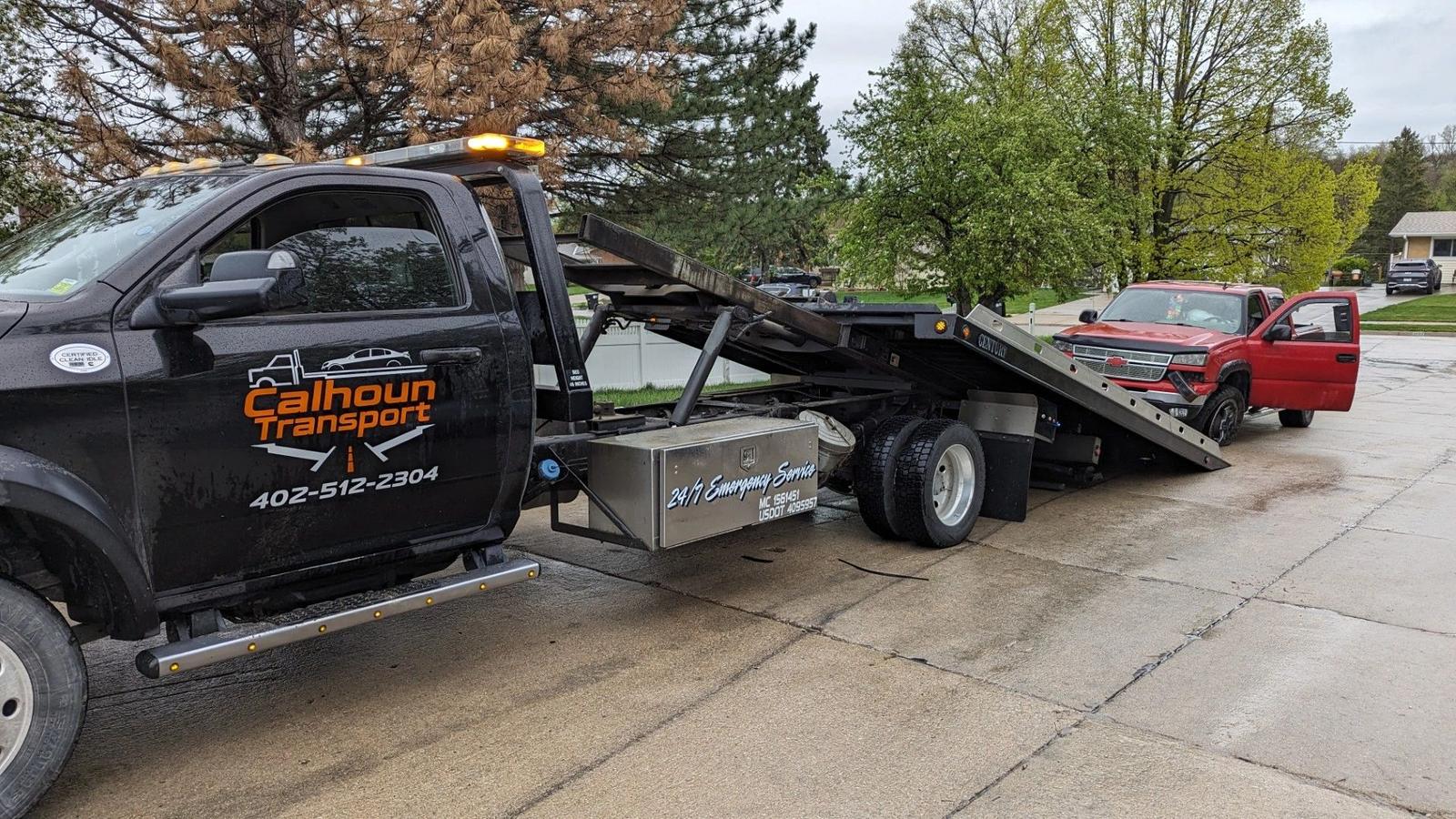
Calhoun Transport runs flatbeds and roadside calls across Washington County and the Omaha metro from a base in Fort Calhoun, day or night. Call 402-512-2304 and describe exactly what the car is doing: whether it clicks, cranks slowly, or does nothing at all. That is usually enough to tell whether you need a jump start or other roadside help or a flatbed. If you are in town, the Blair service area page has the local detail. For anything that is not urgent, send us the details instead.