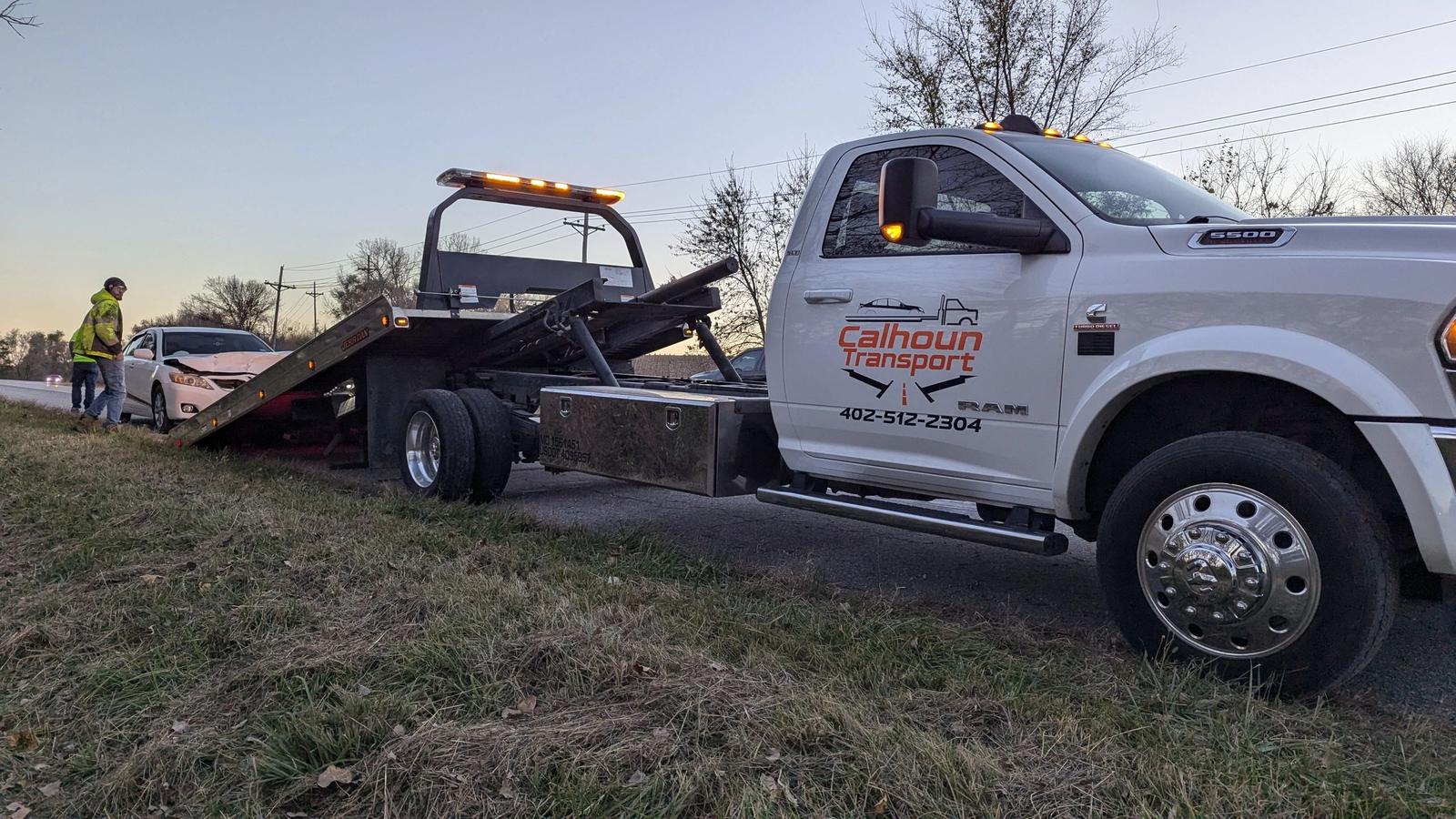
If your vehicle quits on a two-lane highway, the safest place to wait is usually behind a guardrail or well up the far side of the ditch, uphill of your car and back from it, never in front of it and never between it and traffic. Standing beside the driver's door feels natural. It is the one spot that puts you between a two-ton object and the lane it might get pushed into.
That single decision matters more than almost anything else you do while you wait. Here is the rest of it, in the order it actually happens.
First 60 seconds: get the vehicle as far right as it will go
A car that is still rolling has options a stopped car does not. If the engine dies but you still have momentum, use it. Steer right, coast as far onto the shoulder as the surface allows, and get the whole vehicle past the white line if you can.
Around Arlington that surface changes fast. US-30 runs along the south side of town and carries most of the through traffic, and the shoulder there is generally paved and wide enough to clear the lane. Get a mile off it onto the county roads toward the Elkhorn River or Bell Creek bottoms and the shoulder becomes a soft gravel edge with a ditch behind it. Dropping a wheel over that edge turns a simple no-start into a recovery. If the shoulder looks soft, stop short of it rather than easing over and finding out.
Hazard lights go on before you come to a stop, not after. On a curve or a rise, they are the only thing telling the car behind you that the shape ahead is not moving.
Then decide: stay in or get out
There is no single right answer, and the wrong answer gets people hurt.
Stay in the vehicle, belted, if you are on a highway with traffic moving at speed and you cannot get fully clear of the lane. A car is a survival cell. Outside it you are unprotected.
Get out and move away if you can exit on the passenger side onto solid ground and put real distance between yourself and the road. That means up the far bank, behind a barrier, or well into the field side of the ditch. Not the shoulder. Not the ditch bottom directly behind your bumper, which is exactly where a vehicle goes when it is struck from behind.
Get out immediately regardless if you smell fuel, see smoke, or the vehicle is on a blind curve where nobody will see it in time.
If you leave the vehicle, take your phone, your keys and anything you need to stay warm. Exit on the side away from traffic and do not walk around the front of the car to get there.
Nebraska's move over law changed, and it now covers you
This is worth knowing because most drivers still think it only applies to police and tow trucks.
Nebraska's move over law was expanded under LB 530, effective in September 2025. It now requires approaching drivers to change lanes away from any stopped vehicle on the side of the highway, not just emergency and roadside assistance vehicles, and it extends to vulnerable road users including pedestrians, cyclists, work crews and agricultural equipment. Where changing lanes is not possible, the driver has to slow to a safe speed and proceed with care.
Two practical consequences. First, the law is on your side while you are standing out there, which is a reason to make yourself visible rather than to hide. Second, it is not a force field. The Nebraska State Patrol issues citations for move over violations every year, which tells you plainly how many drivers do not comply. Position yourself as though nobody will move over, and treat it as a bonus when they do.
Be seen, then be somewhere safe
Visibility and position are two different problems and people tend to solve only the first one.
- Hazard lights stay on. In daylight they are a weak signal, at dusk and after dark they are the main one.
- Dome light on at night if you are staying inside. It shows there is a person in the car.
- Reflective triangles or flares behind the vehicle, if you carry them, placed at a distance that gives a driver time to react rather than right at your bumper. On a rise or a curve, put the first one where an approaching driver can first see the spot.
- A hi-viz vest in the glovebox is the cheapest safety item in the vehicle and almost nobody has one.
- Do not stand behind the vehicle waving. You are in the impact zone and you are hard to see against the shape of the car.
Between Arlington and Blair, roughly fifteen miles of that route runs through open country with long sightlines and few streetlights. That cuts both ways: drivers can see you from further out, and they are also moving faster and paying less attention than they would in town.
Kids, pets and cold
Children stay belted in their seats if the vehicle is staying put. Moving a small child to a ditch in the dark introduces a bigger risk than the one it removes, unless the vehicle itself is unsafe.
If you are getting everyone out, get everyone out together and move as a group to one spot away from the road. Pets stay leashed or crated. A loose dog on a highway shoulder is a hazard to the dog, to you and to the driver who swerves.
In cold weather, run the engine for heat only if the exhaust pipe is clear of snow and the vehicle is not in a ditch or drift. A blocked pipe pushes exhaust into the cabin. Ten minutes of heat, then off, is the usual advice. Keep a blanket in the vehicle from October on.
What to tell the operator
Two minutes of clear information on the phone decides which truck leaves the yard, and that decides how long you wait.
- Where you are, precisely. The highway and the nearest mile marker or cross road beats a town name. "US-30 about two miles west of Arlington, north shoulder" is a dispatch. "Near Arlington" is a search.
- Which side of the road you are on, and whether you are fully off the lane, half on it, or in the ditch.
- What the vehicle is and whether it rolls, steers and shifts into neutral. All-wheel drive matters. So does a lowered ride height.
- What happened. A no-start, a flat, a blown hose and a collision are four different trucks and four different loads of gear.
- Whether anyone is hurt, in which case the first call is 911, not a tow company.
If you are somewhere exposed, say so. It changes the order things get done in.
Frequently Asked Questions
Should I stay in my car or get out on a Nebraska highway?
Stay in the vehicle with your seatbelt on if you cannot get fully clear of the traffic lane. Get out and move well away from the road only if you can exit on the passenger side onto solid ground, or if there is smoke, a fuel smell, or you are stopped where approaching drivers cannot see you in time.
Where is the safest place to stand while waiting for a tow truck?
Behind a guardrail if there is one, otherwise well up the far side of the ditch, back from your vehicle and uphill of it. Never between the vehicle and traffic, never directly behind the rear bumper, and never in the lane. Distance from the road matters more than distance from the car.
Does Nebraska's move over law apply to a regular broken down car?
Yes. Since the LB 530 expansion took effect in September 2025, drivers must change lanes away from any stopped vehicle on the side of the highway, not only emergency and roadside assistance vehicles. If they cannot change lanes, they must slow to a safe speed and pass with care.
What information does a tow operator actually need from me?
The highway and nearest cross road or mile marker, which side of the road you are on, how far off the lane you are, the make and model, whether it rolls and steers, and what went wrong. That set decides which truck and which equipment come out, which is what determines your wait.
How long should I expect to wait in a rural area?
It depends on where the nearest available truck is and what else is running. Distance between towns in Washington County means a rural call takes longer than a metro one. Ask for an estimate when you call, and call back if conditions change, because a vehicle that was safely off the road can stop being safely off the road.
Get a truck moving
Calhoun Transport runs roadside assistance and flatbed towing across Arlington, Fort Calhoun, Blair and the wider Omaha metro. If the vehicle went off the edge rather than simply stopping, that is a winch out recovery and it is worth saying so on the phone.
Call 402-512-2304. Tell us where you are and which side of the road you are on, then get yourself somewhere safe and stay there.