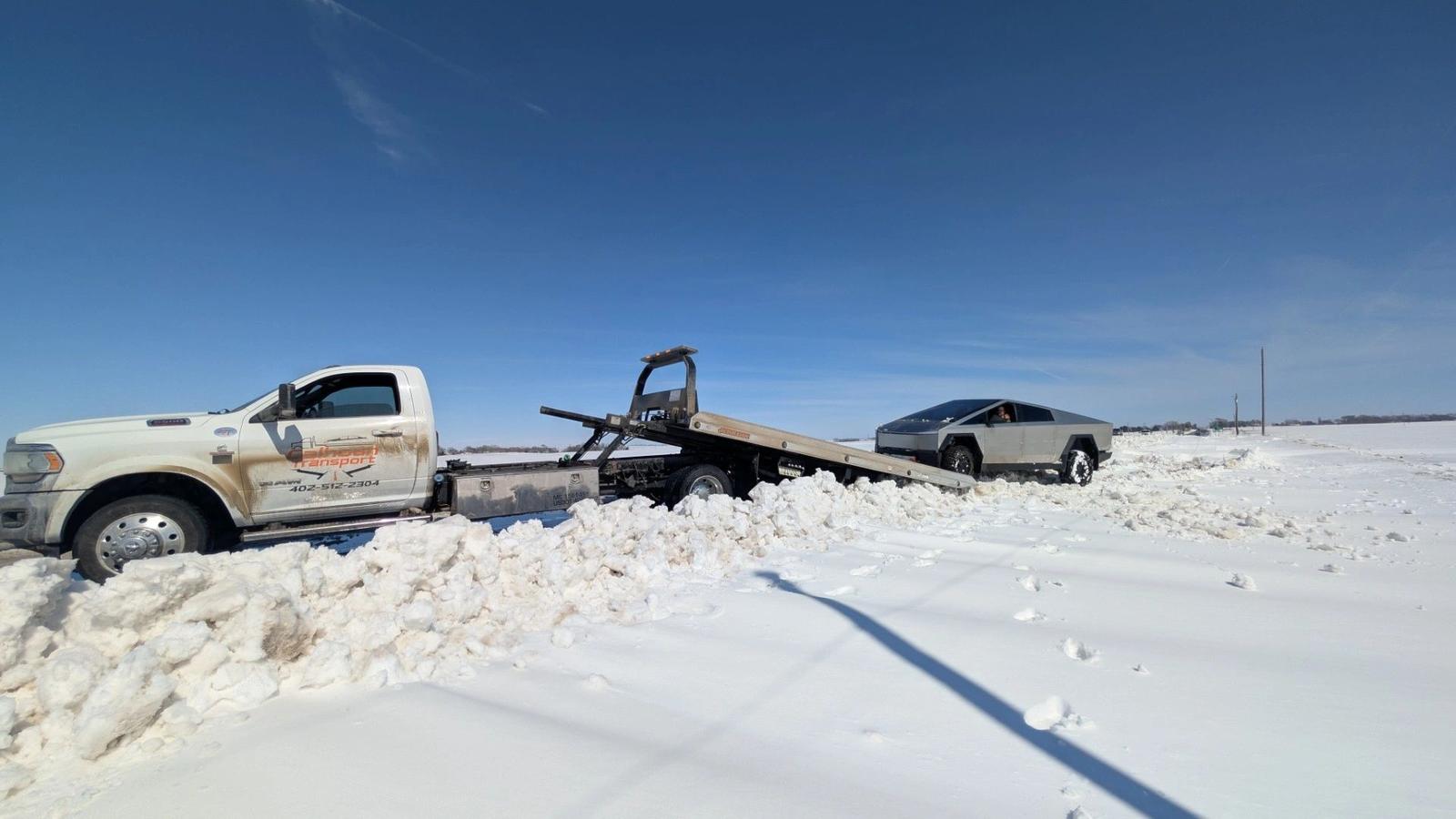
Most cars that end up in a Nebraska ditch in winter are undamaged. They slid off a shoulder, dropped a wheel over a soft edge, or drifted wide on ice, and the vehicle itself is fine. Getting it out without bending anything is a recovery, not a tow, and it is priced differently. What causes the damage is usually the rescue, not the slide.
Two seasons, two causes
Winter is the obvious one. A March 2025 blizzard closed US-75 between Omaha and Blair, closed I-80 west of the metro, and knocked out power to tens of thousands of OPPD customers. The Nebraska State Patrol logged dozens of motorist assists during a single March 2026 storm. Snow fills roadside ditches so completely that a vehicle sitting in one can be invisible from the road, which is a hazard in its own right.
Spring is the quieter one and it catches more people out. When frost comes out of the ground, a gravel shoulder that held all winter stops holding. Washington County describes itself as roughly 30 percent creek and river bottoms, with the Missouri River bottomland along its eastern edge running three to seven miles wide. That is a lot of ground that is firm in February and soft in April.
Why a strap from a passing pickup is a bad idea
Somebody stopping to help is guessing about two things they cannot see.
- Where it is safe to attach. Modern unibody cars have a small number of designed recovery points and a great many things that look like recovery points and are not. A strap on a control arm, a subframe lip or a bumper beam will move the car and bend the part.
- How much force is involved. A snatch strap stores energy and releases it all at once. That is what makes it effective and what makes it dangerous. Recovery gear that fails under load becomes a projectile, and people are seriously hurt this way every winter.
There is a third problem that is less obvious. A vehicle in a ditch usually has to come out along a line the road does not offer, so the pull needs to be redirected with a snatch block or the truck needs repositioning. A straight tug from whichever direction a helpful stranger happens to be parked in is how a stuck car becomes a damaged car.
What a proper winch out looks like
The work starts before anything is attached. Where the vehicle is sitting, what it is sitting on, and which way it has to come out. Two minutes of looking prevents most recovery damage.
Then the line goes on a rated recovery point, tension comes up gradually instead of in a snatch, and the direction of pull gets changed if the geometry needs it. The vehicle moves under control. Afterwards it is worth checking whether anything got bent on the way in, because that is not always obvious from the driver's seat, and a vehicle that is not safe to drive away should go on the deck instead.
What you can do before the truck arrives
- Stop trying to drive out after the first attempt. Spinning wheels dig the vehicle in deeper and can overheat a transmission or a clutch, and every attempt after the first makes the recovery harder and more expensive.
- Stay with the vehicle if you are well clear of the traffic lane. In cold or poor visibility that is usually safer than standing outside it, and a snow-filled ditch hides a car from other drivers.
- Note what the ground is. Ditch, field, mud, snow or shoulder, and how far off the road you are. That decides which truck and which gear come out.
Frequently Asked Questions
Is a winch out cheaper than a tow?
Usually yes, because there is no loaded delivery at the end of it. The vehicle comes out, you check it over and you drive away. Price depends on how far off the road it is and how hard the pull is, so describe the situation on the phone and you will get a real number.
My car is in a ditch but looks undamaged. Do I need a tow?
Probably not. Most ditch recoveries end with the vehicle driving away under its own power. A good operator will look it over once it is back on solid ground and tell you honestly whether anything bent on the way in, rather than assuming a tow is needed.
Can a tow truck reach a car stuck in a field?
Sometimes, and it depends entirely on the ground between the road and the vehicle. A truck that gets stuck reaching you has made the situation worse. Describe how far in it is and what the ground is like, and expect an honest answer about whether it is a job for a flatbed or a tractor.
Should I let someone pull me out with their truck?
It is riskier than most people realise, both for the car and for the people involved. Attachment points and stored energy in a snatch strap are the two problems. If the vehicle is only slightly off the edge and there is a rated recovery point, it can work, but a controlled winch line is what the job actually calls for.
If your car is off the road now
Calhoun Transport runs winch outs and recoveries across the Omaha metro and Washington County from a base in Fort Calhoun. Call 402-512-2304 and describe the ground the vehicle is sitting on. There is more on how recoveries are done on the winch out and recovery page, and if it turns out the vehicle needs to go somewhere, that is covered under flatbed towing. Local detail for the county is on the Blair and Fort Calhoun pages. If it can wait, send the details through instead of calling.