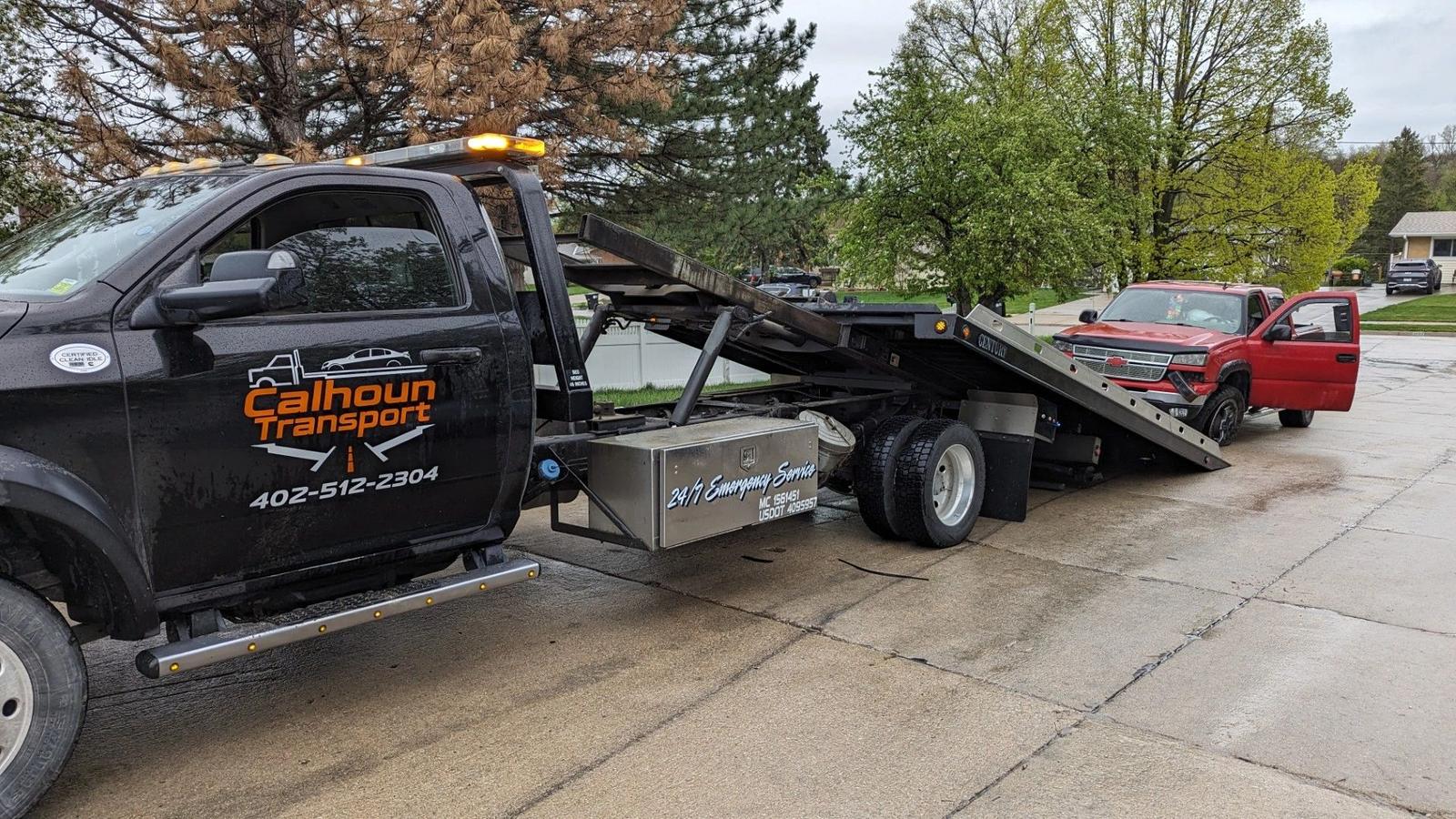
A tow goes faster when the first minute of the call covers five things: where the vehicle actually is, what it is, why it stopped, whether it still rolls and steers, and where it is going. Everything else can be worked out when the truck arrives. Those five decide which truck gets dispatched, what equipment comes with it, and how long you sit there waiting.
Most people call a tow company two or three times in a lifetime, so nobody has practice at it. Here is what an operator is listening for.
The five answers that get a truck moving
Where you are, in terms a driver can use
A street address is best. A cross street is nearly as good. What does not work on its own is a description of the surroundings, because the surroundings look the same for several miles in most directions once you are outside a subdivision.
If you are on a county road with no address in sight, the map application on your phone will give you a set of coordinates or a nearest-address estimate. Read that out. It is far more useful than a landmark, and it removes the guessing entirely.
Two more details belong in this same answer: which side of the road you are on, and whether the surface under the vehicle is pavement, gravel, grass or mud. The first tells the driver which direction to approach from. The second tells us whether the vehicle can be pulled straight onto a deck or has to come out of somewhere first.
What the vehicle is
Year, make and model. If you do not know the year, the model and a rough idea of the generation is enough.
This is not small talk. A lowered car, a long wheelbase pickup, a van with a roof rack and a small sedan all load differently, and some will not load at all on the wrong equipment. Tell us if the vehicle sits low, if it is all wheel drive, or if anything in or on it changes the height or the weight. A vehicle loaded down with tools or cargo is worth mentioning too.
Why it stopped
You do not need a diagnosis. "It died while I was driving and will not restart" and "it will not start in the driveway" point at different problems and sometimes at different solutions.
Be specific about what you heard and what you saw. A grinding noise, a sudden loss of power steering, a dashboard that lit up, steam, a flat, a smell of fuel. If it went off the road, say so plainly and say how far. A vehicle sitting in a ditch is a recovery, not a straight pickup, and it needs a winch out and recovery setup rather than a simple load.
Sometimes the answer to this question means no tow at all. A dead battery in a driveway, a flat on a shoulder or an empty tank can often be handled with roadside assistance and you keep driving your own vehicle.
Whether it rolls, steers and shifts
Three separate questions, and all three matter.
Rolls means the wheels turn freely. A seized brake, a locked axle or a wheel that came apart changes the equipment list. Steers means the front wheels will follow the winch line onto the deck instead of fighting it. Shifts means the transmission will come out of park, which on a vehicle with no electrical power is not a given.
If you are not sure, say so. That tells the operator to plan for the harder version and bring what covers it. An uncertain answer treated as a yes is how a truck arrives without the right gear.
Where it is going
A shop name and address, your home address, a dealership, a body shop. If the destination is closed, say so, because a drop at a closed business is a different job with different handling of the keys.
If you have not decided yet, that is fine, but decide before the truck is loaded rather than after. Changing the destination mid-tow is possible. It is just slower and more expensive than deciding once.
What to do while you wait
Get somewhere safe first and stay there. If you are on a shoulder, the inside of a vehicle with a lane of traffic beside it is not the safe option that it feels like. Our post on roadside safety around Arlington covers where to actually stand and why.
Then do three things.
Pull your belongings together, including anything in the trunk, the glovebox and the door pockets. If the vehicle is going to a shop, you may not see it again for a while, and retrieving a wallet or a garage remote from a locked lot is a wasted afternoon.
Have the plate number ready, along with your name and a phone number that will be answered. If there is an insurance claim, the claim number saves a call later.
Keep your phone charged and audible. Drivers routinely call from the road to confirm an approach, and an unanswered call on a rural road turns a ten minute arrival into a half hour of driving in circles.
What slows a pickup down
A few things add time, and most of them are avoidable once you know about them.
An address that does not exist yet. New construction and recently platted streets are not always in every mapping database. If your street is new, give a cross street and the nearest established intersection as well.
A vehicle that cannot be reached. A car boxed in by two others in a driveway, or parked nose first in a tight garage, has to be freed before it can be loaded. If you can move whatever is blocking it before the truck arrives, do that.
Nobody at the vehicle. Unattended pickups are fine and we do them regularly, but they have to be arranged up front, with keys, authorization and access settled on the call.
A second problem nobody mentioned. A flat on a vehicle that also will not shift out of park, a seized steering column, a vehicle half in a ditch rather than on the shoulder. Mention all of it. There is no benefit to making the job sound easier than it is, and the truck that shows up is chosen from what you said.
Before the truck leaves with your vehicle
Walk around it with your phone and photograph all four corners and both sides. It takes a minute and it settles any later question about what condition the vehicle was in before it was loaded. Do the same at the destination if you can be there.
Confirm the destination out loud with the driver, and confirm what happens with the keys if the shop is closed and there is a drop box. Get a name and a number for the driver or the dispatcher. Then ask what happens if the shop cannot take it, because a vehicle arriving at a full lot after hours needs a plan, and the time to make that plan is before the deck goes down.
Frequently Asked Questions
How long will it take a tow truck to reach me around Bennington?
It depends on where the nearest available truck is, what it is finishing, and how far off a main road you are. The honest answer comes from the dispatcher on the call, once they know your location and the equipment the job needs. Ask for an estimate, and ask to be called if it changes.
Do I have to be with my vehicle when it is towed?
Not always. Unattended pickups are common, especially from a shop lot or a driveway. It needs to be arranged during the call so that keys, access and authorization are settled before the driver leaves. Turning up to an empty vehicle nobody mentioned is the version that causes problems.
Should I call my insurance company or a tow company first?
If you are somewhere unsafe, call for the tow first and sort the paperwork out afterward. If the vehicle is parked safely and you are not in traffic, checking your policy first can be worth the few minutes, since some policies cover towing and will want the claim opened before the vehicle moves.
Will a flatbed work for my vehicle?
For most vehicles, yes, and it is the gentlest way to move one because all four wheels come off the road. Flatbed towing handles lowered cars, all wheel drive vehicles and anything that does not roll or steer well. Tell us what the vehicle is on the call and we will bring what fits it.
What information should I have written down before I call?
Location or cross street, year and make of the vehicle, plate number, what happened, whether it rolls and steers, and the destination address. Your name and a phone number that will be answered. If there is an insurance claim, the claim number.
Calling for a tow around Bennington
Calhoun Transport runs flatbed towing, recovery and roadside work out of Fort Calhoun, covering Bennington and the rest of the Omaha metro and Washington County area. We are insured and we operate under USDOT 4095957 and MC 1561451.
If you need a truck now, call 402-512-2304 and start with the five answers above. If you want to know what we cover in your area before you ever need us, our Bennington service area page lays it out, and you can reach us anytime through the contact page.